By: Scott Hendler, AXM’s Paid Search Manager and Benjy Bain, AXM’s Associate Director of Paid Search
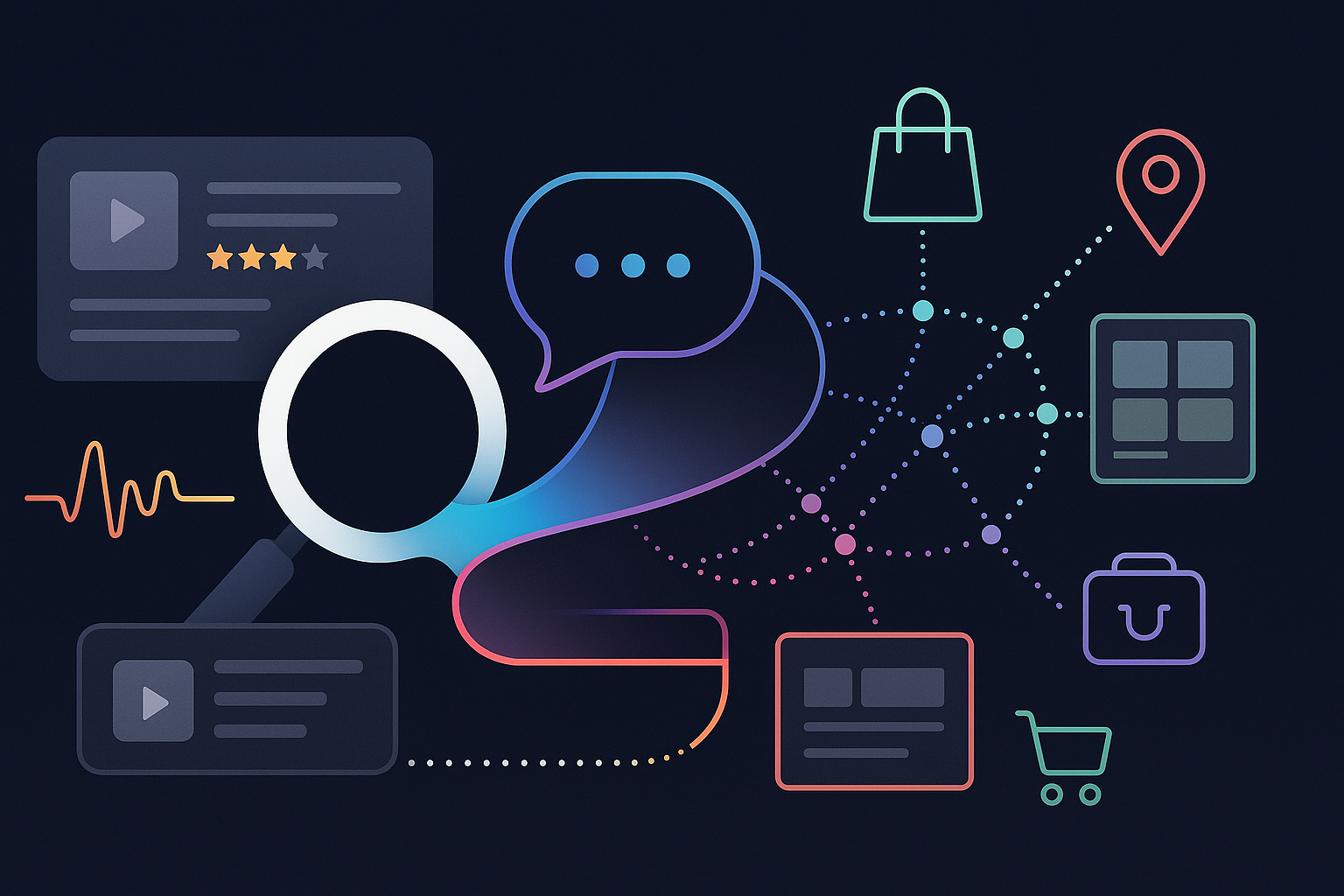
Search has always been the connective tissue between consumer intent and brand visibility. But in 2025 and looking ahead, it looks nothing like the keyword-driven era most marketers built their strategies around. The user journey is now dynamic, fragmented, and increasingly AI-driven. For CMOs and marketing leaders, this means search can’t be treated as a single channel anymore—it’s become a multi-front battlefield for attention, discovery, and conversion.
From Keywords to Conversations
Search began with keywords: simple strings matched against indexed landing pages. Effective for direct queries, but clumsy for complex or nuanced questions. Then came semantic search. Google’s Hummingbird update (2013) introduced algorithms that understood intent and context, shifting the focus from isolated keywords to meaning.
Today, we’re in the conversational era. Natural language processing and voice assistants like Alexa, Siri, and Google Home have normalized speaking to search engines as if they were people. Large language models (LLMs) now power interfaces that can retain context, answer layered queries, and deliver personalized responses in real time. Search is no longer about entering the right keyword—it’s about asking the right question.
The Rise of Zero-Click Searches
Google’s AI Overview and Featured Snippets are reshaping user behavior. More searches end on the results page itself, with no need to click through. This “zero-click” phenomenon already dominates the majority of Google queries. ****In 2024, 58.5% of all searches resulted in zero clicks, where the user either went on to make another search or did nothing and the browsing session ended. Equally concerning, almost 30% of clicks were directly to another Google owned property (YouTube, Images, Maps, Google Flight, Google Hotel etc)
For brands, this poses a clear challenge: how do you capture value when the search engine itself delivers the answer? Success now depends on treating the SERP like a branded landing page. Ads and extensions must deliver immediate utility—whether that’s price transparency, store locators, or compelling CTAs. Content should be structured for Google’s AI to surface it: short paragraphs, clear headers, bullet points, schema markup. If your brand isn’t optimized for snippets, it’s invisible in the moments that matter.
New Gatekeepers: Retailers, Social Platforms, and AI Assistants
Perhaps the biggest shift is that Google no longer owns the entry point to search.
- Retail Media Networks: More than half of U.S. consumers now begin their shopping journey on Amazon, not Google. Retailers like Amazon, Walmart, and Target are leveraging first-party shopper data and proximity to purchase to capture search-driven ad dollars. For advertisers, this means higher purchase intent but also higher competition in a pay-to-play environment.
- Social Search: Platforms like TikTok, Instagram, Pinterest, and YouTube are becoming discovery engines in their own right. TikTok alone reports that 57% of its users use the search function to find products, with 23% starting a search within 30 seconds of opening the app. Social search is highly visual, authentic, and powered by UGC, making it particularly influential for younger demographics.
- AI-Powered Chatbots: Tools like ChatGPT, Perplexity, and retailer-led assistants such as Amazon’s Rufus and Walmart’s Wallaby are shifting consumer behavior again. Instead of sifting through a list of links, shoppers can ask, “Find me a blue outdoor jacket under $100 from a certified B Corp” and receive curated recommendations instantly. These experiences are frictionless, conversational, and set consumer expectations higher than ever.
What This Means for Marketing Leaders
The evolution of search isn’t about replacing SEM—it’s about broadening the definition of where high-intent consumers live. To stay competitive:
- Redefine Your Definition of Search Strategy: Shift from a Google-heavy model to include retail media, social search campaigns, and AI-driven environments. Plan content on discovery platforms, TikTok, Instagram, Pinterest, and YouTube, with search-like intent in mind.
- Invest in Content Structuring: Optimize content for AI Overview and snippets to capture zero-click visibility.
- Leverage Long-Tail and Conversational Keywords: Evergreen campaigns should reflect how people actually ask questions, not just how they type them.
- Treat Social as Search: TikTok, Instagram, Pinterest, and YouTube are discovery platforms first—plan content and paid placements with search-like intent in mind.
- Experiment with AI Assistants: As consumers adopt chat-driven search, being early with structured data and LLM-ready campaigns could secure long-term advantages.
The Bottom Line
Search in 2025 is no longer a single channel but a distributed ecosystem spanning Google, retail media, social platforms, and AI-powered assistants. CMOs who continue to optimize only for traditional search risk falling behind. The winners will be those who adapt quickly, experiment widely, and treat every new entry point as a chance to meet consumers where their intent lives.